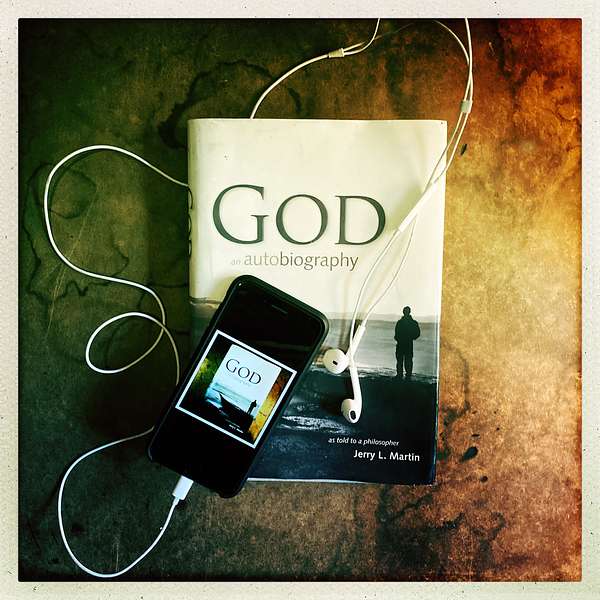
GOD: An Autobiography, As Told to a Philosopher - The Podcast
GOD: An Autobiography, As Told to a Philosopher - The Podcast
261. What’s Your Spiritual Story: Amanda on Love, Trauma, and Discovering a God Who Suffers With Us
What’s Your Spiritual Story? is a continuing series from God: An Autobiography, The Podcast that invites real people to share the journeys that shaped their spiritual lives. Each episode explores how the search for meaning, identity, and connection unfolds through personal experience—and how God meets us in surprising ways.
In this week’s conversation, Amanda joins Dr. Jerry L. Martin to reflect on the path that brought her from a childhood marked by instability to a life of seeking, learning, and slowly opening toward the spiritual dimension.
She describes how psychology and philosophy helped her make sense of the world, how meditation and sacred texts offered moments of grounding, and how discovering a God who suffers with us reshaped her understanding of love and presence. Her story highlights the quiet ways growth can emerge from vulnerability and how even confusion, pain, and uncertainty can become part of a meaningful spiritual journey.
If you’ve ever wondered whether God is present in the difficult places of life—or whether your own story “counts” as spiritual—this episode offers gentleness, curiosity, and hope. It’s a reminder that the search itself matters, and that there are many ways God reaches out along the way.
Other Series:
The podcast began with the Dramatic Adaptation of the book and now has several series:
The Life Wisdom Project – Spiritual insights on living a wiser, more meaningful life.
From God to Jerry to You – Divine messages and breakthroughs for seekers.
Two Philosophers Wrestle With God – A dialogue on God, truth, and reason.
Jerry & Abigail: An Intimate Dialogue – Love, faith, and divine presence in partnership.
What’s Your Spiritual Story – Real stories of people changed by encounters with God.
What’s On Our Mind – Reflections from Jerry and Scott on recent episodes.
What’s On Your Mind – Listener questions, divine answers, and open dialogue.
Stay Connected
- Share your thoughts or questions at questions@godandautobiography.com
- 📖 Get the God: Book
- 📖 Get Two Philosophers Wrestle with God
Share Your Story | Site | Facebook | Instagram | Twitter | YouTube
Scott Langdon [ 00:00:17,220 ] This is God: An Autobiography, The Podcast — a dramatic adaptation and continuing discussion of the book God: An Autobiography, As Told to a Philosopher by Jerry L. Martin. He was a lifelong agnostic, but one day he had an occasion to pray. To his vast surprise, God answered — in words. Being a philosopher, he had a lot of questions, and God had a lot to tell him.
Scott Langdon [ 00:00:58,920 ] Episode 261: Hello, and welcome to God: An Autobiography, The Podcast. I'm Scott Langdon, and on this week's episode, we have another very special spiritual story, and it's coming from inside the house.
Scott Langdon [ 00:01:25,430 ] Our very own Amanda Horton, who handles all of our social media and all the words you see on the different platforms that offer our podcast, the descriptions, the timestamps, the corresponding links, all of that wonderful, juicy stuff that makes the details pop. That's part of what Mandi does. Today, you'll get to experience part of who Mandi is, as she recently sat down with Jerry to share her spiritual story. Mandi's story is both deeply moving and genuinely inspiring. Believe me, your life will be better for getting to know Amanda. Here's Jerry to get things started. I hope you enjoy the episode.
Dr. Jerry L. Martin [ 00:02:12,890 ] Well, I'm so glad we can have this interview. Everybody calls you Mandi, except me, and I call you Amanda because it's one of my favorite names. It means beloved. And what could be better than every time I see you, here is beloved, here is Amanda.
Dr. Jerry L. Martin [ 00:02:36,610 ] But be that as it may, if we... I've started calling theology, which I talk about a lot in terms of theology without walls, but I've started redefining it. It was the title I took from Hans le Grand’s book. Though the phrase had been used before, Hans came up with it, but life-seeking understanding. The traditional definition was faith, which really means one revelation, one body of faith seeking self-understanding, you know, how to understand it, how the people in that community received it can understand it. But that tends to be rather rarefied, not only because it's only one tradition. But it's not the whole of life.
Dr. Jerry L. Martin [ 00:03:21,670 ] And I think, you know, what you really need to seek understanding about is the whole of life. There is even some question about this series of whether to call... I started with, what is your story? Everyone has a story. And, well, that seemed too open-ended. And Scott said, why don't we say, what is your spiritual story? Because that's our special interest at God: An Autobiography, The Podcast.
Dr. Jerry L. Martin [ 00:03:51,320 ] But your whole life is part of your spiritual story, right? And everybody's life starts off somewhere. And at one point I was told, an awful lot of the 'What you have to do in life'— the first task in life is something like diagnostic. You know, what is my situation? And what are its pluses and minuses? What does it give me? What challenges does it present? But anyway, think about that for a moment. Where would you start your story, Amanda, in terms of your life situation and challenges, and opportunities it presented?
Amanda H. [ 00:04:38,640 ] I would say... Well, I think it's important to get a scope of a full life story to understand a spiritual story because it is so intertwined. I can't say specifically when I was younger I felt like I had a relationship yet with God, but now, older looking back, I can see it very clearly.
Amanda H. [ 00:05:05,150 ] So sometimes it's something that develops over time and understanding. I don't think I was even awake or conscious as an individual until I was safe, which was around 18, 19, but you know, how safe is an 18 or 19 year old either? You know, you're out. I was out working a lot, actually in restaurants working really late and, I would say after that period of time I started to actually try to make sense of the world. And that's when I started to discover a little bit more about spirituality. I started gravitating towards psychology and philosophy. I think my first... experience was with this really nice woman I was working with when I was 17.
Amanda H. [ 00:06:04,950 ] We were doing princess parties and it was so fun. We would each dress up like one of the princesses and you could get to be different ones each time. But the classics, Cinderella, Sleeping Beauty.
Dr. Jerry L. Martin [ 00:06:20,000 ] That's a great idea. I've never heard of that.
Amanda H. [ 00:06:22,650 ] Oh, and she had this Italian seamstress who did like all of the gowns and they were gorgeous. And like, it was every girl's dream, including the little girls who were getting the party. So the people, the people doing the parties, were having just as much fun. But she took me, the owner took me to, and we went to a Chinese meditation group.
Amanda H. 00:06:46,120 ] And I forget what it meant now, but I remember the way that chant and prayer felt being in a group of people and how I actually could feel a difference in the vibration and that piqued my interest. Like, okay, now I'm feeling something going on too. So there's something further here to investigate.
Amanda H. [ 00:07:05,570 ] And then I think my religious experiences after that, which would be just like kind of touch points with God, was my mom was Catholic, and we did go to church a couple of times when I was younger. We weren't really like allowed to explore that too much further. But when I was older, I was in a relationship with someone who was Catholic and I practiced Catholicism for about seven years, every Sunday going to church, going to, you know, mass. I was not allowed to receive communion though so I definitely felt a little like an outsider because I didn't receive all of my sacraments beforehand. So just me and a few other people would sit back when they're doing the communion. So I felt a little, of course, you know, not fully integrated into that community.
Amanda H. [ 00:08:06,710 ] And anytime I asked how I could get to that point, I was met with so much resistance. It would take a lot of time. It would, you know, be too long. Maybe they didn't have adult classes. I kind of just stopped there pursuing it. And I think then I just started going more so towards psychology and philosophy and stoicism to kind of explain the world around me.
Dr. Jerry L. Martin [ 00:08:37,270 ] If we go back to the Catholic context. I'm very surprised to hear that. Why was it so hard? I never heard it was hard. Or were they sort of throwing up obstacles or emphasizing problems that weren't necessarily that big, that you could have overcome? Or am I misreading the..
Amanda H. [ 00:09:05,560 ] No, you're reading between the lines very accurately actually. So I was marrying this person I was going to this church with and we were part of the parish. And it was known we were living together already. And we had to do the pre cana classes, his brother was a priest.
Amanda H. [ 00:09:28,680 ] And it was really bizarre throughout the entire planning of the ceremony, you know, you can't get married outside, which was something I wanted. You have to stick to very traditional music. We had other traditions, cultural traditions that were added in there, too. And everything was just very strict. And it took the individuality out of the union. The two people up there coming together. And I think they were putting up that barrier because we lived together. I don't think that they wanted to spend that time on me.
Dr. Jerry L. Martin [ 00:10:06,100 ] People have lived together for a very long time.
Amanda H. [ 00:10:08,810 ] Yeah, seven years is the wrong time.
Dr. Jerry L. Martin [ 00:10:10,390 ] It seems very surprising. But that... I don't know. Anyway, that was the attitude, it seems. So this was a very traditional parish or priest or somebody in that situation. And, so anyway, that ended up a dead end for you. Instead of doors opening, doors were closed in front of you. And so you moved on, looking for wisdom elsewhere, it sounds like. Go to see what psychology and philosophy can teach you, what you can learn from them. Is that about right?
Amanda H. [ 00:10:50,610 ] Yeah. When I was younger, I was... living in a really difficult environment and something about psychology really piqued my interest and it was nature versus nurture. Um, and I started studying more psychology and then I found out that the situation I was in when I was younger.
Amanda H. [ 00:11:16,020 ] My dad was not my real dad, who I thought was my dad. It was my whole identity everything was changed it was a whole ruse. Um, so then I thought, 'Oh my gosh,' nature versus nurture. Like, you know, I have my mom who's wonderful. So I have nature or I'm sorry, I have nurture and nature. Her. But nothing but evil from the other side. So I thought, 'Oh, good.' Now that I know this huge secret about myself, you know, the secret's out, I'm able to be me. Who's my dad? Right. And so I look him up and he's a murderer. He's a murderer and he's in jail and he will be in jail for the rest of his life. He's a terrible person. The crime scenes committed are—
Dr. Jerry L. Martin [ 00:12:01,329 ] I just can barely take that in, this is like the dramas I watch on TV late at night, I have to think: I've got to go watch something more gentle but to find this in your own life. Your father is a murderer and in prison and will never be out of prison. And as far as anybody can see, has no redeeming qualities?
Amanda H. [ 00:12:32,370 ] No, and I guess the question looms, like, would I ever reach out? I don't think he's a very good person, though. I have found like half siblings who have said the same thing. So I think I would stay away. But yeah, no way. It was such a bizarre I was so excited. And then after that, I think I wasn't so sad about my... dad being who he was. I think I was more shattered that my theory didn't make sense now. There was no nature or nurture. So how did I turn out to...
Dr. Jerry L. Martin [ 00:13:03,630 ] It was a lie, you might say, just a big deception. He was not your father at all. And whatever qualities you had hoped or projected or been given to believe he would have, he did not have. He was this and wow how you breathe deep and take that in. Let's study some psychology.
Amanda H. [ 00:13:30,990 ] I did. Actually, in ninth grade, I remember doing a 20-page report on the Son of Sam. I've always been interested in psychology. Because of the environment I was in, I had to learn how to read emotions very quickly. So psychology has always been interesting to me.
Amanda H. [ 00:13:50,160 ] And that really helped me out a lot. I think I got a lot of guidance that I couldn't get spiritually yet because I wasn't open, at least in finding little doorways telling me that what I was feeling, this thing I was missing this connection to God is possible because everything I thought was wrong, a lie. Everything I thought was a lie. It's all changed. So then philosophy really helped me out because I think I started gravitating mostly towards stoicism. That really saved me because I felt really out of control of everything. Like I can't control any of what had gone on. And even later in life, you know, things happen.
Amanda H. [ 00:14:40,450 ] So I found a lot of comfort in the stoic practices of journaling, meditation, and a lot of comfort in the wisdom of accepting that the only thing you can control is your response to the world around you.
Amanda H. [ 00:15:03,520 ] And then I found... The Tao Te Ching. And I started reading some Miyamoto Musashi. I started reading… I always get confused with what I read because it was through actually a yoga certification. And there was a whole spiritual component to it, which I loved. So I've read the Bhagavad Gita, the Yoga Sutras, the Vedas And... I can't remember if the Upanishads are a separate part or if that's like encompassing all of that, but that was what our study covered.
Dr. Jerry L. Martin [ 00:15:49,670 ] Yeah, that's the entire basic corpus of the Hindu tradition, the thing that you named.
Amanda H. [ 00:15:58,170 ] Do you know? I read that probably, Jerry, like 20 times too, because it was pretty short. And I think at the time I had been traveling, so it was perfect opportunity to just like read over and over again. And I never understood it until you… I forget what episode recently you were talking about it, but you retell the story in a way that it's finally like, okay, now I understand. It's a very confusing thing to read because I didn't know who Krishna, if we're talking about Krishna, or if we're talking about he has a few names I think, throughout the entire story, that they're kind of interchanging. So it took a lot of focus and I just. I was grateful when you recapped it. And I was like, okay, now I missed the whole chariot sinking and everything.
Dr. Jerry L. Martin [ 00:16:44,820 ] Yeah, and that's not in the Bhagavad Gita, the chariot wheels, but it's in the events around the Bhagavad Gita. One problem is people read only the Bhagavad Gita, and yet that's a key part. It's one encounter between our hero Arjuna and Krishna, who's both a friend of Arjuna and divine, and a god. It's one conversation between them. where Krishna was explaining to Arjuna that he has to do his duty, which means to fight in the battle. He's the crucial warrior in the battle of good against evil. But the whole context, there's a context leading up to that conversation, and of course, the consequent events from it. And most people don't read any of those things. I was pleased to see one publisher has brought out a kind of... small publication that's the Bhagavad Gita in the Mahabharata and contains this surrounding setting, the dramatic setting, and consequence of that episode. Well, that's more than anyone needed to hear about that.
Amanda H. [ 00:18:04,300 ] No, it's fascinating because the chariot sinking gives the resolution of the story. That's the most important, I think. I think, if I had known that, I would have been able to kind of capture the rest of what I was reading a little bit easier, because there was no consequence up to that point. Other than the conversation, I think. And yeah, that's a big consequence to have this chariot just sink enough into the ground. That's interesting. I'm trying to think what happened after that or what I was doing. I think, after that, I went to psychology again.
Amanda H. [ 00:18:42,490 ] And I finished my degree, but at this point I was doing more research, which was interesting. So a lot of my research projects were like statistically figuring out if married couples who had spirituality in their relationship, whether or not they were happier or healthier. A lot of my work centered around Gestalt therapy, perception and I think I always, you know, when you don't have a reality growing up or your reality is constantly changed by someone else, you're constantly looking for ways to kind of make it right. And science really helped with that wherever I was going.
Amanda H. [ 00:19:33,850 ] um, And then after that, I felt like... you know, really, uh, upset. I had just graduated, gone through COVID with my kids at home while going to school. It was very hard. But I did it and I did it with grace, which was the most important part. You know, you don't want to be a crazy lunatic while you're stuck at home with everyone either. So I felt great about it. And then I just couldn't find a position that... I even wanted. And I prayed for this position. I prayed for a position with purpose and found it shortly after. The position with you shortly after. And I think… well, there was a few things in the book that drew me. One thing that drew me the most was I have an inclination to be open and trust stories. Like if someone were sharing this with me, I would have open ears. It's fascinating to me and I want to hear.
Amanda H. [ 00:20:51,800 ] And soak in and absorb more, but... As I was reading the book, I felt like your conversations were so close to what I would have asked myself that it became bizarre almost. It just was so readable because of that, where your brain was going during each timeline or with each culture in seeing what God was up to with each culture. And I just, it was just an immediate trust. I was hooked. I was hooked. And then coming across this section on Zoroastrianism also, really was intriguing to me because having experienced a little bit of Buddhism and a little bit of just studying other more Eastern spiritual thought.
Amanda H. [ 00:21:52,810 ] Jumping to a monotheistic God. You know, in polytheism, I think we have a lot of different gods representing certain human aspects. So we're seeing like a parallel in that. Monotheism, we have like one being that's going to have to encompass all of that dynamic complexity. Um, And when I was reading the section on Zoroastrianism, and we see God has an evil side, I was... like, okay, that's a God I can trust. I can trust a God that's suffered.
Dr. Jerry L. Martin [ 00:22:25,260 ] Most people, I think, would be appalled. But you can trust this kind of God. Why? It sounds more realistic or what?
Amanda H. [ 00:22:34,690 ] Yeah, I mean, I just don't, and maybe this is assuming God would have the same psychology as a human being, which of course may not be the case, but I feel like if you don't suffer, as a human at least, how can you feel empathy and compassion? You can feel sympathy, but you can't understand the pain or even understand what pain is if you're not even experiencing pain. The idea of having a God watching and being separate from the suffering or perfect or all-knowing. It just seemed, that seems scary to me. That seems scary. I want a God who knows what suffering is because that's a God who can help.
Amanda H. [ 00:23:27,590 ] Or have empathy, you know? At least in my mind. So I was hooked after that. And then, from there, I... I finished, God: An Autobiography, and I've done a lot of work since in many different areas, like you were just talking about. Hans' book, Life-Seeking Understanding, that was an incredible project. So was Two Philosophers.
Dr. Jerry L. Martin [ 00:23:53,130 ] Yeah, it used to really serve as a kind of editorial. A reader of the various publications we brought out as part of the Theology Without Walls series. You went through each manuscript and caught errors, suggesting improvements. And that was very valuable. And it's a lot of work and probably kind of interesting, at least for me, as putting these things together, bringing them into one publication series. There's a lot of learning because these different authors are doing very different things.
Amanda H. [ 00:24:28,100 ] They all are, and they're all fascinating. It was incredible to... go through the whole series each one from start to finish was just really interesting to watch the whole project... Also, it was interesting to see the authors, like, see it finished. I thought that was really cool. I've never experienced that before.
Amanda H. [ 00:24:57,550 ] And I remember when I was younger, one thing I used to do was I would go to the library and find the oldest books on the shelf and just look through the indexes to see what was in there, if there was anything interesting or weird. And I remember thinking about that when I was making the index for Two Philosophers Wrestle With God, just like, oh gosh, if my 12-year-old self only knew what I was doing now. She would be so proud.
Dr. Jerry L. Martin [ 00:25:26,050 ] That's an interesting trait of the inquiring mind that you exhibit, Amanda, that you found the indexes interesting. And I often do that too. I'll immediately go to the back of the book and see who all is listed. And bibliographies and this kind of thing. Even acknowledgements, who are they thanking?
Amanda H. [ 00:25:48,340 ] Yeah, it tells you so much.
Dr. Jerry L. Martin [ 00:25:50,060 ] The indexes tell. the scope of the book.
Amanda H. [ 00:25:55,140 ] Yes.
Dr. Jerry L. Martin [ 00:25:55,480 ] So, okay. And then you see, oh, maybe that's something I should read too.
Amanda H.[ 00:26:03,410 ] Yeah, or when you're 12, when you're going through a 12-year-old.
Dr. Jerry L. Martin [ 00:26:06,410 ] Well, later, you're making a long list.
Amanda H. [ 00:26:09,850 ] I'm trying to find any weird words and they're like, 'Oh, what does that mean on pg 93?'
Dr. Jerry L. Martin [ 00:26:13,500 ] Yeah, that's right.
Dr. Jerry L. Martin [ 00:26:46,660 ] What have been, I guess, I have a sense of challenges, and I was going to ask about... What are the sources of strength or inspiration or guidance in your life? Or maybe the question would be, 'What are the sources of safety?' You know, what can you trust, I guess, is the one way of putting the question. What in life have you found you can trust?
Amanda H. [ 00:27:12,620 ] I remember when I was younger, being sat down and told that there's no such thing as unconditional love. And it was like an hour-long conversation, so it was really being drilled in. And I remember the whole time thinking, 'I love my sisters and my mom so much.’ My brother wasn't born yet, but if he was, I would have been thinking the same thing. That's not true. It was the biggest glaring lie I could have ever seen... And that moment I think changed a lot for me because I knew without knowing, you know, more of the lies to come throughout the years.
Amanda H. [ 00:27:57,250 ] I knew that there was such a thing as unconditional love. I unconditionally loved my siblings, my mom, and my children now. I think. Love is really what... got me through. I'm lucky enough to be the oldest of my siblings too. So there was a very strong sense of protection. And we have that throughout adulthood. We're all really close now still.
Amanda H.[ 00:28:24,510 ] And like I said, I have a brother too. So he's part of our pack now, although greatly outnumbered. Poor guy. But yeah, I think love. I think love and humor. I always tried to be really funny and make everyone laugh or distract them or, you know, I had a job to do and that really helped me.
Amanda H. [ 00:28:53,340 ] And I did it well. I think I think we got out of it and we're all doing great in many ways. You know, it's a lot to get through, but... I have to say we're all kind of, it's interesting to see us all kind of like open up as we get older, even my mom to more spiritual beliefs. Like my grandpa had passed right before coming on board, and my mom, I forget what it was now. I think she felt like he had left something for her and it was really weird because it wasn't there and she had turned around and it was. I can't remember the specifics. But it was almost like she was embarrassed to tell me.
Amanda H. [ 00:29:40,590 ] And it was just so great that she did because I don't think she would have ever opened up and told me that before. And I think, who cares if the ghost of my grandpa left that dime there for you or if it was coincidentally there. You're enjoying a thought about grandpa. Let's celebrate and talk about this. Don't be nervous about telling me you think he visited, you know. So it's been nice to kind of open them up a little bit too, more.
Amanda H. [ 00:30:10,580 ] And now with the work that I do, I'm always studying something new. One thing that I find really interesting right now— I've been going through, I've never really read the Bible of all things. The language, just for some reason, I couldn't. I just couldn't, I don't know. I don't know what it was. I even had the simplified Bibles. I just couldn't figure out what the stories were. Abigail changed my worldview with understanding the biblical stories as narratives, and some of them are dramatic and romantic and just... makes so much more sense viewing it in that way. I think before I would read it and think, 'Okay, who is this that we're talking about?' I need to memorize who this is and who the son is. I just didn't know what was going on. And now I have more historical context. So I've been having a lot of fun going through just the traditional Bible and absorbing it for the first time in a way that I'm comprehending it.
Amanda H. [ 00:31:12,090 ] But one thing that was fun, I went through, I was studying some of the different animals in the Bible and then going back through and seeing how soon they were actually, my husband was doing it first. He was, um, talking about the Leviathan and, oh my goodness, why can't I remember the other name?
Amanda H. [ 00:31:35,920 ] They're these beasts, basically, that come up in the Bible and then I was like, where do we see that first? And we kept kind of going back and back and back and back. And you can see the same repeat of a similar idea kind of showing up of this specific animal. So there's so many mysteries in there. God's just really cool. God is really cool and interesting. And I wish more people would explore that. And if I had known that, I would have explored Him a lot sooner too.
Dr. Jerry L. Martin [00:32:06,120 ] You know, the... people about the Bible. I had not really read it. I mean, growing up, I heard stories because we went to church. But... As an adult, I never, and as a child, I never sat down and read it, you know, beginning to end. You hear stories. You're told stories in Sunday school. And then I looked for, like, commentaries, what would help me understand this. And what I found were the best were not the theologians that always look for proof texts for their theological theses, you know. But and not the historian people that try to say, 'Oh, this text is earlier than that text.' And you kind of, it ends up falling like ashes through your fingers. But the literary people do a wonderful job. They're not embarrassed by God's so-called anthropomorphic characteristics. God is a character in the story. And so they write about God in these people and the stories and what's happening and do it with insight and without embarrassment and without trying to make it into a thesis of some kind, but just let's go along with the story.
Dr. Jerry L. Martin [ 00:33:21,680 ] Let's see what's happening. Why are the people reacting this way? Why is God reacting that way? You know, people often think, 'Oh, God isn't as serene and perfect as he's supposed to be.' Well, why? You know, the literary reader can just see He's a character. What's He up to? And what's He up to that's being frustrated?
Dr. Jerry L. Martin [ 00:33:46,010 ] You know, at a particular point so that He almost regrets having created mankind at all. You know, well, why is that? What went wrong? What did He want to happen? What did He think would happen? Maybe his expectations weren't realistic for the kind of beings He's created, after all. So anyway, it's all fascinating. If you can, read it. Like a really good novel as a related series of stories.
Amanda H. [ 00:34:19,590 ] Yeah, I'm surprised, and maybe there is one out there, I'm surprised there's not, like, a comic book or something out that can, like, show these stories and, like, maybe more visual ways to bring it to a younger audience, because these stories are really interesting and intense. And had I had them drawn out for me in a way or laid out for me in a way that I could have understood what was going on, yeah, they're fascinating, I would have paid attention a lot sooner.
Amanda H. [ 00:34:48,600 ] What were you saying right before that? Because there was something. I was going to add in: I lost my thought. I think what I was going to say was: I think one thing, too, that really helped from God: An Autobiography was figuring out how to pray and also praying. In a way that had a little bit more mindful meaning.
Amanda H. [ 00:35:18,890 ] So I think my prayers often were pretty, just generic. But I've found since reading the book, a lot of times when... A lot of times when I pray, I'm praying to sit with God to help God through God's suffering. Because if I'm doing all right and I hear something on the news, which is every single day, sometimes it's hard not to just think about all of the awful things that are going on, and if God is suffering with us, how badly God must be suffering as well. And I'm saying that as a parent, if I had to watch my children go through pain and suffering on the global level. I can't imagine how much, how painful that must be.
Amanda H. [ 00:36:11,840 ] So I try to kind of rally God if I can in my prayers. And I don't know if that sounds insane or not, but it's definitely helped me build a more trusting connection to not only God, but to myself. So when I'm praying, I know I'm checked in. I'm not just praying selfishly. I'm thinking about what's going on with God right now? What's God's story right now? And why am I here? What am I doing? What can I do?
Dr. Jerry L. Martin [ 00:36:42,500 ] You know, I often think about all the importance of love in the world. But I always feel love is not sufficiently analyzed, you might say. Well, what is love? An awful lot of love is just what you're describing right now, Amanda. You feel God's suffering. Have compassion for it, sympathy for it, empathy. Empathy would be the right category. God cares about your suffering, you care about God's suffering. And one of the things you do in prayer is share your own suffering.
Dr. Jerry L. Martin [ 00:37:22,350 ] And you take that one step farther than that. You don't just share your suffering, but you're aware that if you're suffering, God is suffering your very suffering, and God's carrying all the other suffering of the world, too. At every moment without filters, you might say, you know, without denial mechanisms and so forth. It's just flooding in. And one of the... Active forms of love, I always think love has to be enacted. It's not just a feeling. You know, or sentimental praise.
Dr. Jerry L. Martin [ 00:37:57,480 ] It needs to be active. In one way, it's active when we just share with each other our suffering. You sympathize or empathize with the other person's suffering, but you also share your own. And that's a gift to the other person. We were talking about suffering and what we just went through with Abigail's broken hip and everything.
Dr. Jerry L. Martin [ 00:38:22,660 ] Although the topic was suffering, the topic that kept coming to my mind was, 'This was a blessing.' I think I wrote about this somewhere because it gave me an opportunity to help her. She needed an enormous amount of help. Because she's got to go through six or seven months before she's completely mobile again. And so I do all of my things and half of her things. But this gives me an opportunity.
Dr. Jerry L. Martin [ 00:38:52,040 ] To enact my love. You know, so sharing her suffering is a blessing for me as a person who loves her. And interestingly, Amanda, you're talking about that in connection with your own relation to God. That perhaps you'd put it the same way, it's kind of a blessing to be able to share God's suffering with God.
Amanda H. [ 00:39:17,200 ] Yeah. I guess that's just love. It is just love when you boil it down. Yeah, that's the way you're engaged in a loving relationship.
Dr. Jerry L. Martin [ 00:39:27,490 ] Well, I was just going to ask... Is there any... Do you feel any sense of direction or future? What are you contemplating. What is on the horizon for your spiritual life or for your understanding of your own life or development of it.
Amanda H.[ 00:39:49,830 ] That's a really good question. I haven't thought about, well, I have thought about that recently, actually. I'vejust kind of recently moved around a little bit, so I've been thinking about going back to church on Sunday. Catholic mass because I do appreciate the ritualistic kind of— I know what I gotta do, and what to say and what to do. So it's not like, 'Ah, what am I going into?'
Amanda H. [ 00:40:24,430 ] I went to a Universal Unitarian church recently, and I was just expecting that same kind of rigidity, and it was just everything was open, and we were reading poems from different cultures, and I was like, 'Wow, this is interesting too.'
Amanda H. [ 00:40:44,090 ] But I think... I don't know where I'm headed. I do want to develop a practice because it's important. And, you know, I don't like to stop and stay stagnant. So this is a good thing to think about and reflect on. I think…Well, I really hope that listeners are encouraged to share their spiritual stories and I'll be busy you know, editing and sharing, helping get those out, because I think that's important. And just continuing with our projects, because this has been my favorite thing in the world. This has just been such a blessing.
Dr. Jerry L. Martin [ 00:41:26,860 ] Well, I think you nicely summed it up in a recent conversation, maybe one of our team meetings in making God accessible or available to people. You know, that's kind of what we're doing with the podcast. Yeah. And that's a wonderful mission.
Amanda H. [ 00:41:47,440 ] I think so. Because think about how many ways God shows up, that is just... There's so much to learn. There's so much to share. There's so many people I can get help and comfort and even sharing the suffering, just like we were talking about, you know, it's love enacted. So I hope that people share their stories and continue to explore their access points to God, whatever it is. If you're thinking about God even as numbers and math, explore that, however God is coming to you. Explore it because you'll be surprised what you find.
Dr. Jerry L. Martin [ 00:42:24,370 ] Yeah. Well, thank you very much, Amanda. Fascinating conversation to me.
Amanda H. [ 00:42:32,290 ] Oh, good. Thank you. I was nervous.
Dr. Jerry L. Martin [ 00:42:35,010 ] Thank you. It doesn't show. If it did show, that'd be fine, too. Who doesn't get nervous? These are heavy topics, after all. What are you asked to do? Reveal the secrets of your spiritual life. But, uh, God, this story, I don't know, you seem like a very, well, I know, you're a very high-functioning human being. And how do you go through your history with a fake father of the sort you had and come through that in one piece. You might say.
Amanda H. [ 00:43:14,420 ] Yeah. I'm still trying to figure that out myself. But I think...maybe just love is the answer. Love and... And God being by my side, because I don't know how else I could have. And I feel like, you know, finding out, when I found out, that I didn't have nature or nurture. God was just kind of tapping me on the shoulder, like, 'This is going to be a mystery that you have to solve.' So I accepted it and I was excited about it. So it's not too bad. It depends on how you look at things, I guess, and perspective. But I was lucky to have the love of my siblings and mom. And I think that's what makes people survive when you're surviving for others. You know, fighting and living for others. That's how you get out: love.
Dr. Jerry L. Martin [ 00:44:10,280 ] Yeah. Yeah. Okay. Well, thank you. Thank you. And I'll see you at the next team meeting.
Amanda H. [ 00:44:17,880 ] Okay, sounds good. Have a good night and tell Abigail I said hi.
Dr. Jerry L. Martin [ 00:44:21,350 ] I will do so. All right.
Amanda H. [ 00:44:24,050 ] Good night. Bye.
Scott Langdon [ 00:44:34,560 ] Thank you for listening to God: An Autobiography, The Podcast. Subscribe for free today wherever you listen to your podcasts and hear a new episode every week. You can hear the complete dramatic adaptation of God: An Autobiography, As Told to a Philosopher by Jerry L. Martin by beginning with Episode 1 of our podcast and listening through its conclusion with Episode 44. You can read the original true story in the book from which this podcast is adapted — God: An Autobiography, As Told to a Philosopher — available now at amazon.com, and always at godanautobiography.com. Pick up your own copy today. If you have any questions about this or any other episode, please email us at questions@godanautobiography.com, and experience the world from God’s perspective — as it was told to a philosopher. This is Scott Langdon. I’ll see you next time.