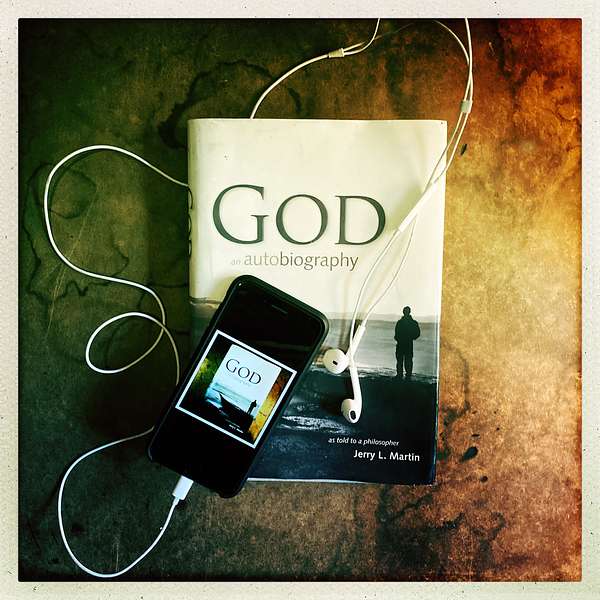
GOD: An Autobiography, As Told to a Philosopher - The Podcast
GOD: An Autobiography, As Told to a Philosopher - The Podcast
268. From God to Jerry to You: How God Speaks Across Religions
Can God speak through more than one religion?
In this episode of From God to Jerry to You, philosopher Jerry L. Martin explores a central insight from God: An Autobiography, As Told to a Philosopher: that divine wisdom may be working through many religious traditions across history, not just one.
Drawing from his recorded conversations with God, Jerry reflects on the idea that different religions may carry distinct spiritual assignments for different cultures and times. Rather than competing versions of truth, these paths may represent a spiritual “division of labor,” each revealing something essential about the divine.
This vision leads to what Jerry calls Theology Without Walls — an approach to faith that remains open to truth wherever it appears, including in other religions, philosophy, literature, science, and lived experience.
He also introduces the idea of a “New Axial Age,” a turning point in spiritual history in which seekers begin drawing wisdom from multiple traditions while deepening their personal relationship with God.
Whether you belong to a particular faith, identify as spiritual but not religious, or are simply curious about how divine guidance might move through different cultures, this episode offers an expansive and hopeful view of humanity’s shared spiritual journey.
Listen, reflect, and experience the world from God’s perspective — as it was told to a philosopher.
Other Series:
The podcast began with the Dramatic Adaptation of the book and now has several series:
The Life Wisdom Project – Spiritual insights on living a wiser, more meaningful life.
From God to Jerry to You – Divine messages and breakthroughs for seekers.
Two Philosophers Wrestle With God – A dialogue on God, truth, and reason.
Jerry & Abigail: An Intimate Dialogue – Love, faith, and divine presence in partnership.
What’s Your Spiritual Story – Real stories of people changed by encounters with God.
What’s On Our Mind – Reflections from Jerry and Scott on recent episodes.
What’s On Your Mind – Listener questions, divine answers, and open dialogue.
Stay Connected
- Read the book: God: An Autobiography, As Told to a Philosopher at godanautobiography.com or Amazon
- Share your questions and reflections: questions@godanautobiography.com
Share Your Story | Site | Facebook | Instagram | Twitter | YouTube
Scott Langdon [ 00:00:17,220 ] This is God: An Autobiography, The Podcast — a dramatic adaptation and continuing discussion of the book God: An Autobiography, As Told to a Philosopher by Jerry L. Martin. He was a lifelong agnostic, but one day he had an occasion to pray. To his vast surprise, God answered — in words. Being a philosopher, he had a lot of questions, and God had a lot to tell him.
Scott Langdon [ 00:00:58,970 ] Episode 268: Welcome to God: An Autobiography, The Podcast. I'm your host, Scott Langdon. And it's time for another episode of the series we call From God to Jerry to You. Today, Jerry Martin dives deeply into the practical reality of what it meant to be tasked with telling God's story. And how God guided Jerry through the ancient scriptures of various religions, explaining what he was up to, what he was trying to communicate to the ancient communities, and why.
Scott Langdon [ 00:01:37,430 ] If we look deeply, we can see how God is present in everything, everywhere, and always has been. And when we seek God and take in all that is offered to us in our daily lives, we grow in our understanding of God's ways and God's will for our lives. Here's Jerry to explain more deeply. I hope you enjoy the episode.
Dr. Jerry L. Martin [ 00:02:02,630 ] Well, I think I might have mentioned... At some time in the past, the project Theology Without Walls— was an assignment given to me in prayer. It occurs toward the end of God: An Autobiography. The basic argument for it is, um, comes from the You might say the perceived fact of divine wisdom. In multiple traditions, not just in one religion. Each religion, as they learn more about the others, tends to think, 'Hey, they have part of the part. of an important story.
Dr. Jerry L. Martin [ 00:02:49,300 ] right somehow.' And then it's a question of what you do with that fact. If you're in your own tradition and then over the walls, you might see, 'Hey, they have some truth too, some truth of a divine order, let's say.' Uh... Well, then you have to figure out what to do about that. And for me, you know, in terms of how this came about, in my interactions with God, you know, one of the first things God said to me that led to the whole book that gives it its title. I want you to tell my story. God told me one day, 'I want early on, I want you to tell my story.'
Dr. Jerry L. Martin [ 00:03:30,440 ] And God gave me the title, 'God in Autobiography.' And I sort of added out of modesty, as told to a philosopher, we don't have God on a tape recorder, but this is an actual transcript, you might say. The book is a sort of transcript of what I asked God and what God told me. So, you know, I didn't know how to tell God's story, but God put me off on the task of reading the ancient scriptures— the foundational scriptures of the world's great religions, all the way back to the ancient Egyptians and the earliest Chinese sources I could find. I was taking them all in, but each one, when I would read these, ancient texts.
Dr. Jerry L. Martin [ 00:04:17,959 ] I would then pray. This was my instruction. Pray and ask God. Well... What were you trying to do with these people? Or you might say, in what they were receiving, what were you trying to get across? And God would answer these questions, and an awful lot of God in autobiography is, as I say, a kind of transcript, a record of God explaining to Jerry.
Dr. Jerry L. Martin [ 00:04:43,560 ] What he was doing with the ancient Chinese, with the ancient Egyptians, you know, all these ancient traditions. And you have all these different stories. They're doing different things, and that was puzzling because here I had come to see and to be told in my prayer life with God— that God is behind them all, you might say, though that doesn't mean they're all infallible and every single thing is right about them, but in some basic way.
Dr. Jerry L. Martin [ 00:05:16,620 ] They're getting something right, that God is communicating something through this and that religion and the next religion and the next one. And that is puzzling. If God is behind them all, why aren't they all saying the same thing? And they don't say the same thing unless you restate it at a very abstract level or basic, you know, be nice to your neighbor or something, you know, platitudes. But, you know, in their... complexity, they're very different one from another and in some cases seem rather opposite.
Dr. Jerry L. Martin [ 00:05:53,380 ] Well, we won't go into that here, but... But I prayed about that, because this is puzzling. Here I'm supposed to be talking about how God, you know, the divine truth, and what is God's story, and yet there seem to be multiple God's stories, you know, as told by each tradition. And so I ask about it, and God's explanation, first point in his explanation was the following, and here I quote from God to Jerry. God explains. Each culture has at a particular time certain human institutional and conceptual resources. Each also has certain traits or talents that I work with. I tell different cultures what they are prepared to hear, and understand, and to act on.
Dr. Jerry L. Martin [ 00:06:53,670 ] Well, that's quite a different picture from anything I had ever gotten anywhere else, that they're getting different assignments because, well, they are different. Their cultures aren't all monochromatic. They're not all identical with each other. In fact, you know, one of the things you'll learn when you start learning about other countries, either through, you know, just travel abroad or you study that you might do in a university course or something like that. You start... learning, well, you know, they're really very, very different in their family arrangements, their mores, their idea of how to greet somebody, you know, all the way down to just do you shake hands or not. The cultures are different. And God gave me an example relevant to... The project I had with kind of figuring out what am I supposed to be making? How am I going to tell this story if God is behind them and God isn't telling them the same thing, therefore they don't say the same thing? And then God helpfully gives me an example, and here's the example. Again, God to Jerry.
Dr. Jerry L. Martin [ 00:08:04,830 ] I told the ancient people of Israel to act in history and to keep my covenant and to abide by a set of religious and moral rules That was task enough for them.I told the ancient people of India to develop the inner life and to get in touch with the transcendental Atman, the self beyond the self. Both were and remain. Valid tasks.
Dr. Jerry L. Martin [ 00:08:40,909 ] Well, that's quite a picture, isn't it? And it was a helpful example for me because... I did see right away, well, you know, you read the stories of Moses and all this stuff, and you see the ancient people of Israel had their... hands full just following out. They've got the Ten Commandments and so on and so forth, and various rules, you know, they can't eat pork and, you know, whatever. All these rules and all legislation, you know, that regulate, you know, your obligations to... To wives and children and parents and all of this kind of thing, and set aside a corner of the field for the poor and traveling people so that they don't go hungry, so you leave one-tenth of the field for them, and all these kind of moral rules.
Dr. Jerry L. Martin [ 00:09:34,280 ] It's going to be hard to do all of that and at the same time sit and meditate, you know, hands up above your knees and say something like 'Aum.' and, you know, empty your mind and get that away from the self that's living all these daily concerns, including going with... the covenant or something, and just get in touch with the self that is behind that self and rather, you know, characterless, just kind of empty. Ja. empty space of self, a self behind the self that in the Hindu tradition is identical with Brahman.
Dr. Jerry L. Martin [ 00:10:16,390 ] So, you can see that, okay, he's now given the people, the Hindus, an absolutely full task to do. And so now it makes sense that the religions aren't all the same and that's the kind of premise. For a theology without walls, you'll start with... well, there's divine wisdom all over. God is kind of behind each of these. We can even come to understand why they have the divinely given tasks that they have, and then we can start, you know, rethinking how they all fit together. And I wondered, you know, given that example, and that it's fine for the people of India to do Atman is Brahman, and for the people of Israel to keep the covenant, and both are valid tasks, and I believe I was told that they remain. Well, that just sounds as if, okay, no news here, folks. The religions simply go on.
Dr. Jerry L. Martin [ 00:11:23,550 ] Well, yes and no. There's something else I was called. This was, again, God to Jerry. The division of labor, that means the diversity of religions. The division of labor, God says, can even continue with people selecting. the vocation that fits their talents or history or calling. But understanding it, in a new way. not as the exclusive path, but as an essential path contributing to the whole.
Dr. Jerry L. Martin [ 00:12:05,280 ] Well, so this is, you know, it sounds like a modest shift, but it's a major shift. Because, in terms of each religion, each religion kind of thought, this is the right story. We've got the right story. The others are going off. All other directions.
Dr. Jerry L. Martin [ 00:12:21,790 ] As I got to know more about others, they tend to often see, well, they weren't as crazy as they looked at the beginning, and they aren't as fully inadequate, and they can start interpreting. The other religions and the divine truth they perceive there as maybe us.
Dr. Jerry L. Martin [ 00:12:39,470 ] You know, less good than their own religion, but nevertheless is having something to offer. And... and as God puts it here, no longer an exclusive path. So, you're following your Christian or Hindu or Buddhist or whatever. Okay, that's an important path. That's an essential path in this answer that contributes to the whole Story.
Dr. Jerry L. Martin [ 00:13:05,590 ] But the story is bigger than that. And. The implications are more dramatic and radical than that. Now what do they go to? It has implications down to the individual.
Dr. Jerry L. Martin [ 00:13:24,120 ] You know, they're going to be these religions with divine truth in them. Well, there's nothing that demands, God isn't here demanding, that you take up the tradition that's predominant in your own culture. You can be an American in the 21st century and decide you feel the call of Hinduism or Tibetan Buddhism or Islam or... or something else. You know, there are many options out there. You can be impressed with the Navajo or the, well, I was interested in Hopi religion for a time. It has some very impressive aspects. The religious options become much more dramatically open.
Dr. Jerry L. Martin [ 00:14:11,070 ] And then, in thinking about the task of theology, This is where theology without walls came in. Well, God is saying you don't really, those walls aren't that important. They're not what's important. Responding to a genuine divine call. To connecting with the divine in a genuine way That's what's important. And that means to do theology, you shouldn't just study your own tradition and the great thinkers in that tradition. That's very rich material in any one of the great religious traditions. It's not the whole story, and it's especially not the whole story for anybody just to pay attention.
Dr. Jerry L. Martin [ 00:14:59,180 ] Only to their own. I mean, they can do that. That's a life option, and there's nothing that God told me that says that this would be a wrong thing to do. However, if you're a theologian, your task— the definition of your task— is to know or, in an articulate way, all you can about the divine reality. The subject matter of theology is not the religions, it's not even your religion. It's the object of your religion. It's the divine reality itself.
Dr. Jerry L. Martin [ 00:15:31,330 ] And if theology is going to be adequate, to its subject matter, to the divine reality itself, it has to take in all the evidence. Every theologian, wherever they start out, if they're going to do the job adequately, have to take in as much of the story as they can. No one has to become a universal scholar, but whatever truth comes your way— that you happen to become aware of. You don't reject it just because it happens to not come from your own tradition. You take it in wherever you find it. If you believe this is divine truth, divine wisdom, and you take it in, and that is theology without walls. You take it in wherever it comes.
Dr. Jerry L. Martin [ 00:16:21,090 ] You don't reject it because, oh, that's not my way, as like people who close their ears and shake their heads and won't listen. No, you listen. You don't just listen, but you take it in and you... and if it seems as true as things you know from your own religion, then you include it in your theology. That's your obligation.
Dr. Jerry L. Martin [ 00:17:06,329 ] Well... You start on. Theology Without Walls. That's a whole new theological project. I sometimes think of retrospective theology, which is what we've known up until now, and prospective. You know, future-oriented theology. It's what we're going to discover once we start.
Dr. Jerry L. Martin[ 00:17:31,700 ] Noticing that, gee, there's divine truth all over the place, and not just in the religions, but in philosophy, and great literature, and some of the greatest, deepest psychologists, and in the sciences, and so on. There's... There's insight into the ultimate divine reality all over the place, and you need to take it in whenever it comes your way. And I was told this, I believe I might have quoted this before on some occasion. But it's... God explained it to me in terms of a new axial age.
Dr. Jerry L. Martin [ 00:18:13,360 ] And the axial here means very much like an axis, a turning, what the wheel turns on. And here it's the whole history of humankind and its relation to the divine turned in the first axial age. And that's the period of several centuries in ancient times. When all of the world's great religions were founded.
Dr. Jerry L. Martin [ 00:18:38,300 ] From one part of the world to another, and they all go back to this. Well, ancient BC, before the Common Era, period of time, by hundreds of years, period of time, and they were founded, the Buddha and people like Socrates and Prophet Isaiah and so forth, they were all back in that ancient time.
Dr. Jerry L. Martin [ 00:19:03,830 ] And... And the religions that we've known since then are often, by scholars, called the Axial Age religions. In other words, those are the religions, for the most part, some rose up later, but most of the religions and the others spun off these ancient religions are the religions that you have in a textbook on world religions today.
Dr. Jerry L. Martin [ 00:19:29,160 ] But I'm told in prayer, and this is toward the very end of God in Autobiography, God tells me. This is God to Jerry. You stand on the threshold of a new spiritual era. A new axial age. For the first time. Spiritually attuned individuals will draw their understanding of spiritual reality not just from the scriptures of their own religious tradition, but from the plenitude of my communications to men and women.
Dr. Jerry L. Martin [ 00:20:10,610 ] And that... is the task for each and all of us. As we now try to live our lives with as much spiritual attunement, spiritual understanding as we can, and especially for people who devote their lives in a scholarly way to this study, like the theologians and religious studies scholars, they need to be engaged not in retrospective theology, sometimes called confessional theology, that is the theology of one's own confession, like for Lutherans, the Lutheran theology, and so on for each tradition.
Dr. Jerry L. Martin [ 00:20:51,770 ] No, it's got to be theology without walls. And this is a revolution. In human understanding, just as that first axial age was a whole leap in human awareness.
Dr. Jerry L. Martin [ 00:21:06,110 ] And we became aware of, you might say, the transcendental aspect of experience, that there's something far beyond just our common everyday experience. And God describes this process a bit. God says to Jerry, as people from different traditions. Appropriate or take in. elements from other traditions they will make something of that. It won't just be a passive reception. It will be a creative. for a dynamic process.
Dr. Jerry L. Martin [ 00:21:42,830 ] For example, This is God giving me this example. For example, as a Christian, takes in the truth of the Atman. Truth in scare quotes because the Hindu truth of the Atman is not the final truth. It leaves the Christian perspective out, for example.
Dr. Jerry L. Martin [ 00:22:05,380 ] Understanding of the Atman will be shaped and expanded. And connected to other elements not present or not so fully present. In the Hindu tradition, as the Hindus or Chinese fully take in the personal God of the Old Testament, as they take in the reality of Jesus They will be transformed.
Dr. Jerry L. Martin [ 00:22:29,420 ] Well, you can see that's quite... You know, it's kind of almost breathtaking for someone who's lived their lives in one tradition to think, 'Oh, you know, I've...' I don't know. I'm a Chinese Confucian or Taoist or something, and now I've got to take in the personal God who's giving the Ten Commandments, and I've got to take in, you know, Jesus and Jesus' ministry and bringing the kingdom of God and so forth. Well, you know, it's just kind of breathtaking, but that's what we're now entering. We're now entering that period.
Dr. Jerry L. Martin [ 00:23:03,440 ] And... I kind of, for some reason, pictured this, even though it doesn't seem to fit what I've just been told As almost, well, we're going to go through a certain period of time during which, oh, we look over the walls and see, oh, this looks... this looks true and that looks true. And we kind of borrow from each other. And I started thinking of it kind of like a big swap meet, you know, oh, you've got something good. Okay, well, let me share this with you and I'll take this from you and we'll... have a wonderful exchange of insights, and that I imagine somehow that exchange of insights would come to an end, but as being one brief, one-time thing. But I ask God, is that the right picture? And God says, no.
Dr. Jerry L. Martin [ 00:23:54,120 ] Of course it won't be the end. There will be new developments and new communications from my side. And new developments and events and consciousness from the world's side. The Cutting Edge of Spiritual Development will continue. And so, well, the contribution I'm making, in addition to publishing God and Autobiography, which is part, you might say, the revelation for this particular phase of spiritual history and of the human interaction with the divine.
Dr. Jerry L. Martin [ 00:24:35,419 ] But as a scholar, my contribution is starting Theology Without Walls. I'm, of course, a philosopher, not a theologian. But I started going to their meetings and getting to know people. And as I advanced, just the very considerations here.
Dr. Jerry L. Martin[ 00:24:53,130 ] They saw the point. They saw the point. Theology Without Walls is a very successful creative movement, even though it's just a few years old now, but it's moving forward and a crucial element. That I'm not sure has been emphasized— maybe as much as we should have been doing in that scholarly context. One tends to be attuned, oh, to the text and the religion. And their doctrines, their ideas, and maybe, oh, their exemplary figures, their rituals and music and this kind of thing that you can study, you might say, as a scholar. crucial element. You can't do any theology.
Dr. Jerry L. Martin [ 00:25:40,160 ] It came to me very early— you can't do any theology. In a sound way. Without spiritual attunement. It's not just an intellectual puzzle. It's not that now, without walls, you look at all the religions and now you've got one of these humongous puzzles with 10,000 pieces and so forth. Puzzles to put together.
Dr. Jerry L. Martin [ 00:26:05,730 ] But no, no, it's not an intellectual thing of how can we fit all the pieces together in some logical way. No, it requires spiritual attunement. You've got to figure out, okay. taking all these things in. What is going to be a kind of spiritual center of gravity or pivot point or something you know revelations, spiritual experience, like every other part of life.
Dr. Jerry L. Martin [ 00:26:37,010 ] rest on something. You might say it has a kind of structure. As a logician, I think of it as a logical structure, but it's probably more than that, a kind of semantic structure, a symbolic structure. But it has a structure, and so you need to kind of tune in. How can I personally? get a handle on this, meaning both get a handle on it as a project of spiritual understanding but also get a handle on it as a project in my own life and attunement. Because the... The ultimate aim is not to have the right theory. of God or of the divine but how to relate to the divine, what it calls upon. Me to do.
Dr. Jerry L. Martin [ 00:27:29,540 ] And... that. is the important step. The point of the theory of understanding is that you hope that will give you a better, more rich, truer, you might say, more complete way to attune, to relate to the divine, to live your life in accord with the divine, in harmony with the divine.
Dr. Jerry L. Martin [ 00:27:58,420 ] I guess what comes to me is that this period of the New Axial Age, with the intellectual side being theology without walls, we're trying to figure it out, but there's the spiritual side where we're each trying to reposition ourselves in light of what we're learning as life goes on. And as we take in more, you know, every time you turn around, you're taking in something else. new. Somebody else is bringing in a new idea. It might be, you know, your Uber driver, you know, is telling you something and you think, 'Oh, gee, I didn't know.' or I never thought of that. So this goes on, and this is the excitement of life, what God in the prayer here called the cutting edge of spiritual development, which happens for a whole civilization, for humankind, but also just in one's own life. And that's... the excitement and the drama of life.
Dr. Jerry L. Martin [ 00:28:55,540 ] Well, we hope that... By this podcast, we're... helping you enact this drama in your own life. And we always love to hear from you. And much appreciate your just tuning in here. Today and hearing this particular set of reflections and of messages from I got an autobiography as told to a philosopher. Thank you.
Scott Langdon [ 00:29:33,880 ] Thank you for listening to God: An Autobiography, The Podcast. Subscribe for free today wherever you listen to your podcasts and hear a new episode every week. You can hear the complete dramatic adaptation of God: An Autobiography, As Told to a Philosopher by Jerry L. Martin by beginning with Episode 1 of our podcast and listening through its conclusion with Episode 44. You can read the original true story in the book from which this podcast is adapted — God: An Autobiography, As Told to a Philosopher — available now at amazon.com, and always at godanautobiography.com. Pick up your own copy today. If you have any questions about this or any other episode, please email us at questions@godanautobiography.com, and experience the world from God’s perspective — as it was told to a philosopher. This is Scott Langdon. I’ll see you next time.
AI CORRECTED VERSION
Scott Langdon [ 00:00:17,220 ] This is God: An Autobiography, The Podcast — a dramatic adaptation and continuing discussion of the book God: An Autobiography, As Told to a Philosopher by Jerry L. Martin. He was a lifelong agnostic, but one day he had an occasion to pray. To his vast surprise, God answered — in words. Being a philosopher, he had a lot of questions, and God had a lot to tell him.
Scott Langdon [00:00:58,970]: Episode 268. Welcome to God: An Autobiography, The Podcast. I'm your host, Scott Langdon, and it's time for another episode of the series we call From God to Jerry to You. Today, Jerry Martin dives deeply into the practical reality of what it meant to be tasked with telling God's story, and how God guided Jerry through the ancient scriptures of various religions, explaining what He was up to, what He was trying to communicate to the ancient communities, and why.
Scott Langdon [00:01:37,430]: If we look deeply, we can see how God is present in everything, everywhere, and always has been. When we seek God and take in all that is offered to us in our daily lives, we grow in our understanding of God's ways and God's will for our lives. Here's Jerry to explain more deeply. I hope you enjoy the episode.
Dr. Jerry L. Martin [00:02:02,630]: Well, I think I might have mentioned at some time in the past that the project Theology Without Walls was an assignment given to me in prayer. It occurs toward the end of God: An Autobiography. The basic fact argument for it comes from the perceived fact of divine wisdom in multiple traditions, not just in one religion. Each religion, as they learn more about the others, tends to think, "Hey, they have part of an important story, somehow." Then it's a question of what you do with that fact.
Dr. Jerry L. Martin [00:02:49,300]: If you're in your own tradition and look over the walls, you might see, "Hey, they have some truth too — some truth of a divine order, let's say." Then you have to figure out what to do about that. For me, in terms of how this came about in my interactions with God, one of the first things God said to me that led to the whole book and gives it its title was, "I want you to tell My story."
Dr. Jerry L. Martin [00:03:30,440]: God gave me the title God: An Autobiography. I added, out of modesty, "As Told to a Philosopher." We don't have God on a tape recorder, but this is an actual transcript, you might say — a record of what I asked God and what God told me.
Dr. Jerry L. Martin [00:04:17,959]: I didn’t know how to tell God’s story, but God set me on the task of reading the ancient scriptures, foundational scriptures of the world’s great religions — all the way back to the ancient Egyptians and the earliest Chinese sources I could find. I was taking them all in, and after reading each ancient text, I would then pray. This was my instruction: pray and ask God, "What were You trying to do with these people? What were You trying to get across?" And God would answer.
Dr. Jerry L. Martin [00:04:43,560]: An awful lot of God: An Autobiography is a kind of transcript — a record of God explaining to Jerry what He was doing with the ancient Chinese, with the ancient Egyptians, and all these ancient traditions. You have all these different stories doing different things, and that was puzzling. I had come to see, and to be told in prayer, that God is behind them all. That doesn’t mean they’re all infallible or that every single thing is right, but in some basic way they’re getting something right — that God is communicating something through this religion and that one and the next.
Dr. Jerry L. Martin [00:05:16,620]: That is puzzling. If God is behind them all, why aren’t they all saying the same thing? They don’t say the same thing unless you restate it at a very abstract level — be nice to your neighbor, and so forth. In their complexity, they’re very different, and in some cases seem rather opposite.
Dr. Jerry L. Martin [00:05:53,380]: I prayed about that, because this is puzzling. Here I'm supposed to be talking about divine truth — God’s story — and yet there seem to be multiple "God’s stories" as told by each tradition. So I asked about it, and God’s explanation began like this, and here I quote from God to Jerry: "Each culture has, at a particular time, certain human, institutional, and conceptual resources. Each also has certain traits or talents that I work with. I tell different cultures what they are prepared to hear and understand and to act on."
Dr. Jerry L. Martin [00:06:53,670]: That’s quite a different picture from anything I had ever encountered — that they’re getting different assignments because they are different. Their cultures aren’t all identical. When you start learning about other countries, whether through travel or study, you see they’re very different in family arrangements, mores, ways of greeting, all the way down to whether you shake hands or not. Cultures are different.
Dr. Jerry L. Martin [00:08:04,830]: God gave me an example relevant to my project of figuring out how to tell this story if God is behind them all but not telling them the same thing. Here’s the example, again God to Jerry: "I told the ancient people of Israel to act in history and to keep My covenant and to abide by a set of religious and moral rules. That was task enough for them. I told the ancient people of India to develop the inner life and to get in touch with the transcendental Atman, the self beyond the self. Both were, and remain, valid tasks."
Dr. Jerry L. Martin [00:08:40,909]: That was very helpful to me. I could see right away the ancient people of Israel had their hands full following the Ten Commandments and various rules, and a whole legislation that regulate obligations to wives and children, and parents, and set aside a corner of the field for the poor and traveling so that they don’t go hungry, and all these moral rules. It’s hard to do all of that and at the same time sit and meditate and say “ohm” and emptying the mind and getting away from the self that’s living all these daily concerns including with the covenant and get in touch with the self behind the self, rather characterless, empty space, that in the Hindu tradition is identical with Brahman.
Dr. Jerry L. Martin [00:09:34,280]: So now it made sense that the religions aren’t all the same. That’s the premise for a theology without walls: divine wisdom is all over, God is behind each of these, and we can come to understand why they have the divinely given tasks they have. Then we can start rethinking how they all fit together.
Dr. Jerry L. Martin [00:10:16,390]: I wondered, given that example, it’s fine for the people of India to do Brahman, and for the people of Israel to keep the covenant, if both tasks remain valid, does that mean the religions simply go on as before? Well, yes and no. Here is something else God told me: "The division of labor — that is, the diversity of religions — can even continue, with people selecting the vocation that fits their talents or history or calling, but understanding it in a new way: not as the exclusive path, but as an essential path contributing to the whole."
Dr. Jerry L. Martin [00:11:23,550]: That sounds like a modest shift, but it’s a major one. Each religion tends to think, "We’ve got the right story." The others are going off in all other directions. As people learn more about others, they may come to see that others aren’t as crazy or inadequate as they first thought. And now, as God puts it, no longer an exclusive path. Your Christian or Hindu or Buddhist path is essential, but it contributes to a larger whole story. But the story is bigger than that. The implications are more dramatic than that.
Dr. Jerry L. Martin [00:12:05,280]: This has implications down to the individual. There’s religions with divine truth in them. There’s nothing that demands you take up the tradition predominant in your own culture. You can be an American in the 21st century and feel called to Hinduism, Tibetan Buddhism, Islam, or something else. The religious options become much more dramatically open.
Dr. Jerry L. Martin [00:14:11,070]: Then, in thinking about theology itself, this is where Theology Without Walls came in. God is saying those walls aren’t what’s important. Responding to a genuine divine call and connecting with the divine in a genuine way — that’s what’s important. That means theology shouldn’t just study one’s own tradition and thinkers. That’s rich material, but it’s not the whole story.
Dr. Jerry L. Martin [00:14:59,180]: The subject matter of theology is not the religions — it’s not even your religion. It’s the object of religion: the divine reality itself. If theology is to be adequate to its subject matter, it must take in all the evidence. Every theologian, wherever they start, has to take in as much of the story as they can. No one must become a universal scholar, but whatever truth comes your way, you don’t reject it just because it doesn’t come from your own tradition. You take it in wherever you find it. If you believe this is divine truth, divine wisdom, you take it in. That is theology without walls.
Dr. Jerry L. Martin [00:16:21,090]: You don’t reject truth because it’s "not my way." Like people who close their ears and shake their heads. You listen, you take it in, and if it seems as true as what you know from your own religion, you include it in your theology. That’s your obligation.
Dr. Jerry L. Martin [00:17:06,329]: So begins Theology Without Walls. I think of past theology as retrospective, and this as prospective — future-oriented theology. We start noticing divine truth all over the place — not just in religions, but in philosophy, great literature, psychology, and the sciences. There’s insight into ultimate reality everywhere, and you take it in whenever it comes.
Dr. Jerry L. Martin [00:18:13,360]: God explained this to me in terms of a new Axial Age — what the wheel turns on in the whole history of human kind in relation to the divine — turned in the first Axial Age, when all the great religions of the world were founded and they all go back to this ancient period of time. The religions that we’ve known since then, scholars call Axial Age religions are the religions you have in text books today. Now we stand at the threshold of a new spiritual era. God said, "You stand on the threshold of a new spiritual era — a new Axial Age. For the first time, spiritually attuned individuals will draw their understanding of spiritual reality not just from the scriptures of their own tradition, but from the plenitude of My communications to men and women."
Dr. Jerry L. Martin [00:20:10,610]: And that is the task for each and all of us. As we now try to live our lives with as much spiritual attunement and spiritual understanding as we can, and especially for people who devote their lives in a scholarly way to this study, like theologians and religious studies scholars, they need to be engaged not in retrospective theology, sometimes called confessional theology, that is, the theology of one's own confession, like for Lutherans, Lutheran theology, and so on for each tradition.
Dr. Jerry L. Martin [00:20:51,770]: No, it's got to be theology without walls. And this is a revolution in human understanding, just as that first Axial Age was a whole leap in human awareness.
Dr. Jerry L. Martin [00:21:06,110]: And we became aware of, you might say, the transcendental aspect of experience, that there's something far beyond just our common everyday experience. And God describes this process a bit. God says to Jerry, “As people from different traditions appropriate or take in elements from other traditions, they will make something of that. It won't just be a passive reception. It will be a creative and dynamic process. For example (this is God giving me this example) as a Christian takes in the truth of the Atman, (truth in scare quotes because the Hindu truth of the Atman is not the final truth, it leaves the Christian perspective out, for example) understanding of the Atman will be shaped and expanded and connected to other elements not present, or not so fully present, in the Hindu tradition. As the Hindus or Chinese fully take in the personal God of the Old Testament, as they take in the reality of Jesus, they will be transformed.”
Dr. Jerry L. Martin [00:22:29,420]: Well, you can see that's quite breathtaking for someone who's lived their lives in one tradition to think, I don't know, I'm a Chinese Confucian or Taoist or something, and now I've got to take in the personal God who's giving the Ten Commandments, and I've got to take in Jesus and Jesus' ministry and bringing the kingdom of God and so forth. Well, it's just kind of breathtaking, but that's what we're now entering. We're now entering that period.
Dr. Jerry L. Martin [00:23:03,440]: And I kind of, for some reason, pictured this, even though it doesn't seem to fit what I've just been told, as almost, well, we're going to go through a certain period of time during which we look over the walls and see, oh, this looks true and that looks true, and we kind of borrow from each other. And I started thinking of it kind of like a big swap meet, "Oh, you've got something good. Okay, well, let me share this with you and I'll take this from you and we'll have a wonderful exchange of insights," and that I imagined somehow that exchange of insights would come to an end, as being one brief, one-time thing. But I asked God, "Is that the right picture?" And God says, no, “Of course it won't be the end. There will be new developments and new communications from my side, and new developments and events and consciousness from the world's side. The cutting edge of spiritual development will continue.” And so the contribution I'm making, in addition to publishing God: An Autobiography, which is part, you might say, the revelation for this particular phase of spiritual history and of the human interaction with the divine.
Dr. Jerry L. Martin [00:24:35,419]: But as a scholar, my contribution is starting Theology Without Walls. I'm, of course, a philosopher, not a theologian. But I started going to their meetings and getting to know people, and as I advanced just these very considerations here.
Dr. Jerry L. Martin [00:24:53,130]: They saw the point. They saw the point. Theology Without Walls is a very successful, creative movement, even though it's just a few years old now, but it's moving forward. And a crucial element that I'm not sure has been emphasized, maybe as much as we should have been doing in that scholarly context, one tends to be attuned to the text and the religion and their doctrines, their ideas, and maybe their exemplary figures, their rituals and music, and this kind of thing that you can study as a scholar. But a crucial element is you can't do any theology.
Dr. Jerry L. Martin [00:25:40,160]: It came to me very early, you can't do any theology in a sound way without spiritual attunement. It's not just an intellectual puzzle. It's not that now, without walls, you look at all the religions and now you've got one of these humongous puzzles with 10,000 pieces and so forth, puzzles to put together.
Dr. Jerry L. Martin [00:26:05,730]: But no, it's not an intellectual thing of how can we fit all the pieces together in some logical way. No, it requires spiritual attunement. You've got to figure out, taking all these things in, what is going to be a kind of spiritual center of gravity or pivot point or something. Revelations, spiritual experience, like every other part of life, rest on something.
Dr. Jerry L. Martin [00:26:37,010]: You might say it has a kind of structure. As a logician, I think of it as a logical structure, but it's probably more than that, a kind of semantic structure, a symbolic structure. But it has a structure, and so you need to kind of tune in. How can I personally get a handle on this, meaning both get a handle on it as a project of spiritual understanding but also get a handle on it as a project in my own life and attunement? Because the ultimate aim is not to have the right theory of God or of the divine, but how to relate to the divine, what it calls upon me to do.
Dr. Jerry L. Martin [00:27:29,540]: And that is the important step. The point of the theory of understanding is that you hope that will give you a better, more rich, truer, more complete way to attune, to relate to the divine, to live your life in accord with the divine, in harmony with the divine.
Dr. Jerry L. Martin [00:27:58,420]: I guess what comes to me is that this period of the New Axial Age, with the intellectual side being theology without walls, we're trying to figure it out, but there's the spiritual side where we're each trying to reposition ourselves in light of what we're learning as life goes on. And as we take in more, every time you turn around, you're taking in something else new. Somebody else is bringing in a new idea. It might be your Uber driver telling you something and you think, "Oh, gee, I didn't know," or "I never thought of that." So this goes on, and this is the excitement of life, what God in the prayer here called the cutting edge of spiritual development, which happens for a whole civilization, for humankind, but also just in one's own life. And that's the excitement and the drama of life.
Dr. Jerry L. Martin [00:28:55,540]: Well, we hope that by this podcast we're helping you enact this drama in your own life. And we always love to hear from you and much appreciate your tuning in here today and hearing this particular set of reflections and messages from God: An Autobiography, As Told to a Philosopher. Thank you.
Scott Langdon [ 00:29:33,880 ] Thank you for listening to God: An Autobiography, The Podcast. Subscribe for free today wherever you listen to your podcasts and hear a new episode every week. You can hear the complete dramatic adaptation of God: An Autobiography, As Told to a Philosopher by Jerry L. Martin by beginning with Episode 1 of our podcast and listening through its conclusion with Episode 44. You can read the original true story in the book from which this podcast is adapted — God: An Autobiography, As Told to a Philosopher — available now at amazon.com, and always at godanautobiography.com. Pick up your own copy today. If you have any questions about this or any other episode, please email us at questions@godanautobiography.com, and experience the world from God’s perspective — as it was told to a philosopher. This is Scott Langdon. I’ll see you next time.